

“This number hasn’t appeared for ages. Surely its turn is coming?” If you follow 4D results, you may have had the same thought. When a number stays off the results board for many draws, some call it a “cold number”, while others see its long absence as a reason to watch it closely.
But “hasn’t appeared for a long time” does not mean “is about to appear”. When draws are independent and every number has an equal chance, previous misses do not give a number an advantage in the next draw. Cold numbers describe the past; they do not predict the future.
What Are 4D Cold Numbers?
A cold number generally refers to a number that has appeared infrequently within a selected period, or has not appeared for many consecutive draws. A hot number, by comparison, is one that has appeared more frequently during that period. However, low frequency and a long gap since the last appearance are different measurements.
Before calling a number cold, check which operator, time period and prize categories the statistics cover. “No first prize for a year” is very different from “no appearance in any prize category for a year”. Mixing operators, prize categories or timeframes can make comparisons misleading.

Why a Long Absence Does Not Improve the Next Draw’s Odds
The key is independence: a previous draw does not change the probabilities in the next one. In statistics, events are independent when the occurrence of one does not affect the probability of the other.
Consider a simplified 4D first-prize model. Suppose each draw selects one first-prize number from 0000 to 9999, all 10,000 numbers are equally likely, and successive draws are independent. Any particular number then has a 1 in 10,000 chance, or 0.01%, of becoming the next first-prize number.
Whether that number appeared in the previous draw or has been absent for 100 draws, its next-draw probability remains the same. The draw does not keep track of how long a number has waited, and numbers do not take turns winning.
The 0.01% figure here refers only to one exact number winning first prize under this model. It is not the combined probability of winning across all prize categories, permutation products or jackpot games.
“It Must Be Due”: Understanding the Gambler’s Fallacy
The belief that a random outcome becomes more likely because it has not happened recently is known as the gambler’s fallacy. It assumes that future results must compensate for an imbalance in the past.
Imagine tossing a fair coin five times and getting heads every time. If the tosses are independent, the probability of tails on the sixth toss is still 50%. Tails does not become more likely simply because it has been absent for five tosses.
The same distinction applies to numbers. “This number has not appeared for a long time” may be an accurate observation. “Therefore, it is more likely to appear next” is a separate claim that the observation does not establish.

Does a Cold Number Eventually Appearing Prove the Method Works?
Suppose someone follows a long-absent number and it eventually appears in the results. It is easy to respond: “See? It was due!”
Yet its appearance only shows that it was drawn on that occasion. It does not prove that its long absence made it more likely to appear. Assessing a prediction method requires looking at unsuccessful predictions too, alongside the number of draws observed and a clear benchmark for comparison.
Likewise, a number that has appeared frequently is not necessarily on a winning streak that will continue. Nor does it need to “take a break”. Under an independent, equal-probability model, recent results give neither hot nor cold numbers an advantage in the next draw.
Long-Term Averages Do Not Mean Numbers Take Turns
Another common question is: if every number has the same chance, shouldn’t they eventually appear about equally often? Does that mean numbers with fewer appearances must start catching up?
This confuses long-term proportions with short-term compensation. Under an independent, equal-probability model, the proportion of draws in which each number appears tends towards its theoretical probability as the number of draws grows. That does not require every number to appear equally often within a fixed period, or less frequent numbers to catch up over the next few draws.
Random results can include clusters, repeats and long gaps. There is no timetable requiring an absent number to appear by a particular deadline.
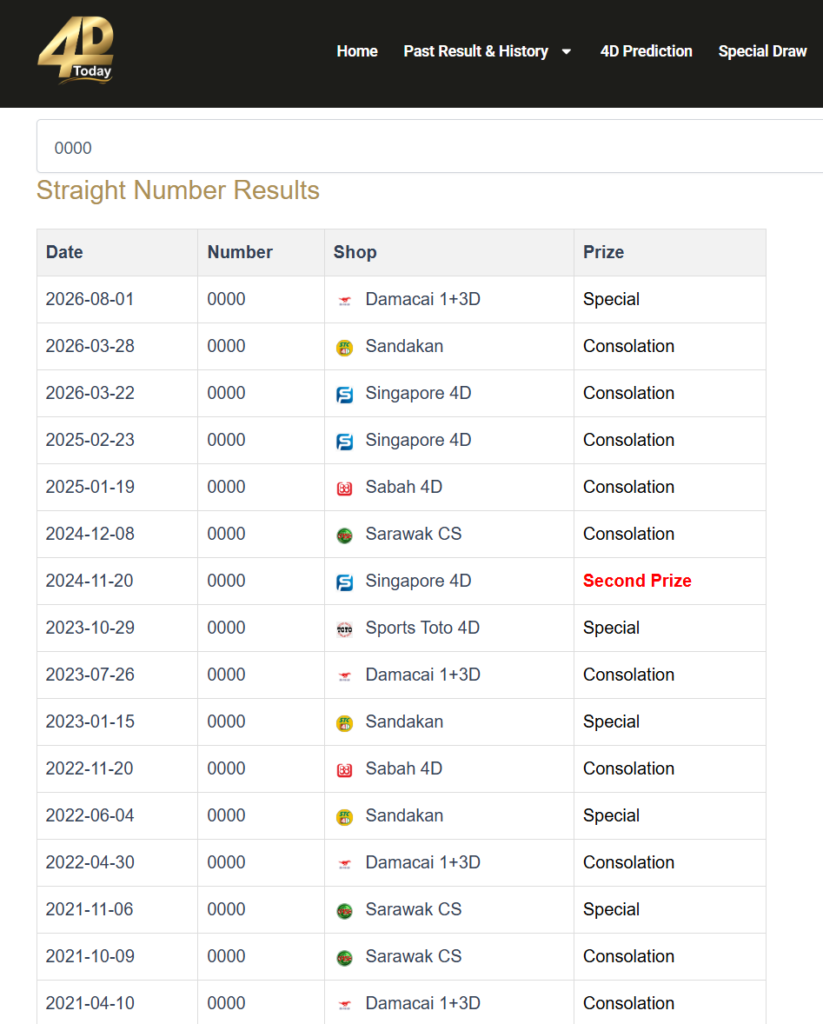
What Can 4D Historical Results Tell You?
Historical results can show when a number last appeared, which prize category it appeared in, and how often it was drawn during a selected period. These are useful records, but they answer “What happened before?” rather than establish “What will happen next?”
When you see claims such as “this cold number is ready to return” or “years without a win means it could hit any time”, look at the records behind them and whether a historical observation is being presented as a prediction.
Cold numbers offer one way to explore 4D results, but a longer absence does not increase a number’s next-draw probability. For more number-related explainers and Malaysian draw information, visit 4D Today.