
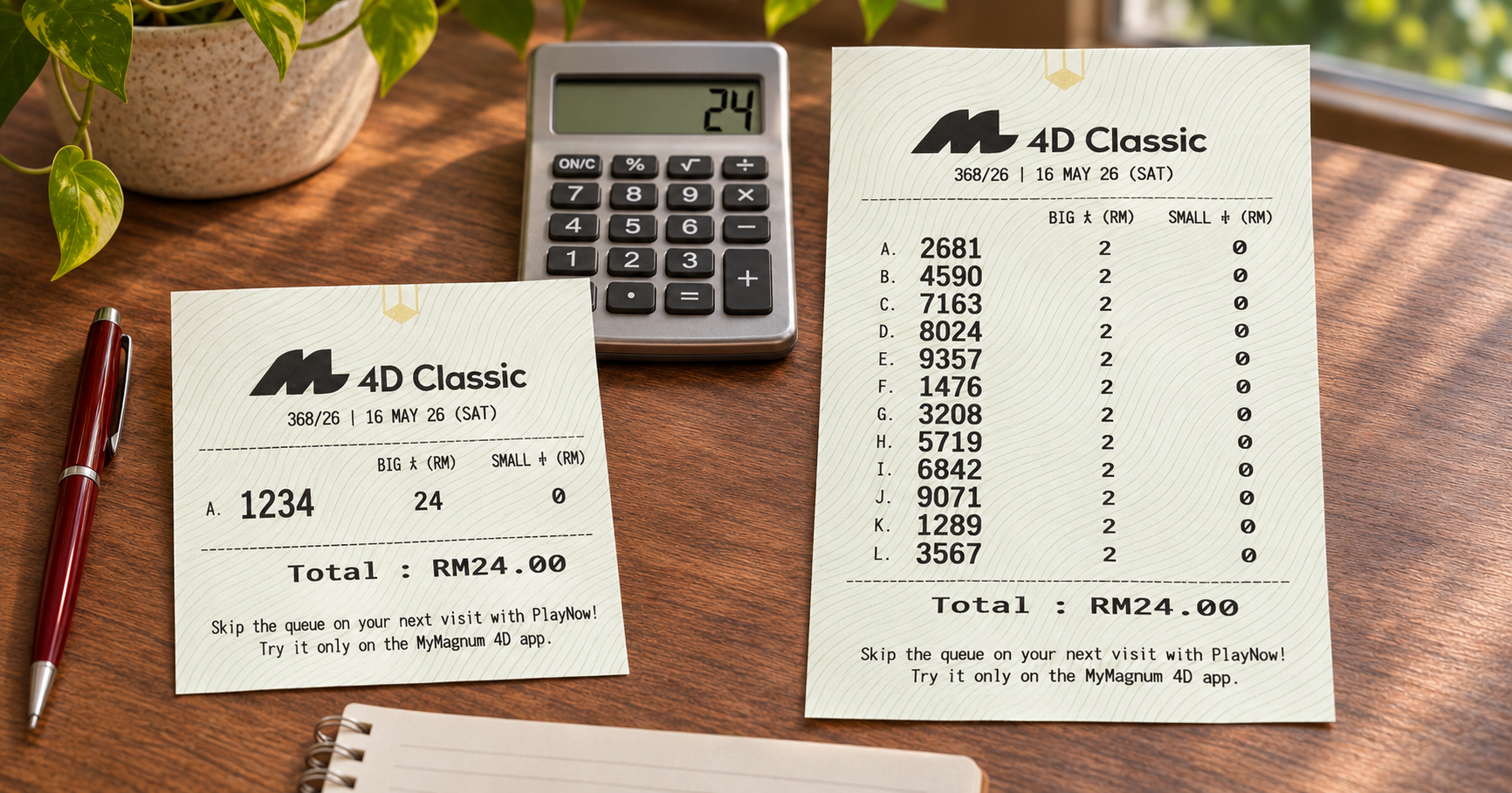
With the same RM24 budget, some players put everything on one 4D number, while others choose 12 different numbers at RM2 each. Which approach makes more sense?
The answer depends on what you are comparing: the chance of winning or the payout when a number wins. They are two different things.
This comparison uses Magnum 4D Classic Big straight bets in a single draw, excluding Small, mBox and Jackpot games. It assumes every number has an equal chance of being drawn and that all numbers in the spread-out options are different.
More Numbers Improve Coverage, but Reduce the Payout per Number
According to the official Magnum game guide, a winning RM1 Big bet pays RM2,500 for first prize.
Here is how three ways of allocating RM24 compare:
| Allocation | Chance of Winning First Prize | First-Prize Payout |
|---|---|---|
| 1 number × RM24 | 0.01% | RM60,000 |
| 4 numbers × RM6 | 0.04% | RM15,000 |
| 12 numbers × RM2 | 0.12% | RM5,000 |
Choosing 12 different numbers gives you 12 times the chance of matching first prize compared with choosing one. However, the first-prize payout is also one-twelfth as much.
Putting more money on a number does not make it more likely to be drawn. It increases the payout if it wins.
Does Spreading Your Budget Offer Better Value?
Not necessarily. Spreading the budget improves the chance of a winning number, but it does not improve the theoretical return per ringgit.
Under these rules, all three RM24 allocations have the same expected prize return of RM15.36. After subtracting the RM24 stake, the expected net result is a loss of RM8.64.
This does not mean you will receive RM15.36 each time. It is a theoretical average calculated across all possible outcomes. An individual draw could return nothing or produce a much larger prize.
Even with 12 different numbers, the probability of winning at least one Big prize is approximately 2.727%, assuming 23 distinct winning numbers are drawn fairly. The probability of winning nothing remains approximately 97.273%.

Buying the Same Number on Three Tickets Is Not Diversification
Suppose you buy RM2 Big on “1234” three separate times. Your total stake is RM6, but you still cover only one number. Under this comparison, that is equivalent to placing RM6 on “1234”.
What matters is the number of different four-digit combinations, not the number of tickets.
“1234” and “4321” are two different numbers. Buying “1234” three times still covers just one.
Understand the Trade-Off
Within the same budget, spreading your stake across different numbers increases coverage. Concentrating it on one number increases the payout if that number wins.
Neither approach makes the numbers predictable or removes the game’s negative expected return.
If you add more numbers while keeping the original stake per number, you are increasing your spending—not making a same-budget comparison.
For results across different 4D brands, visit 4D.Today.